Open source
DALT.PHP
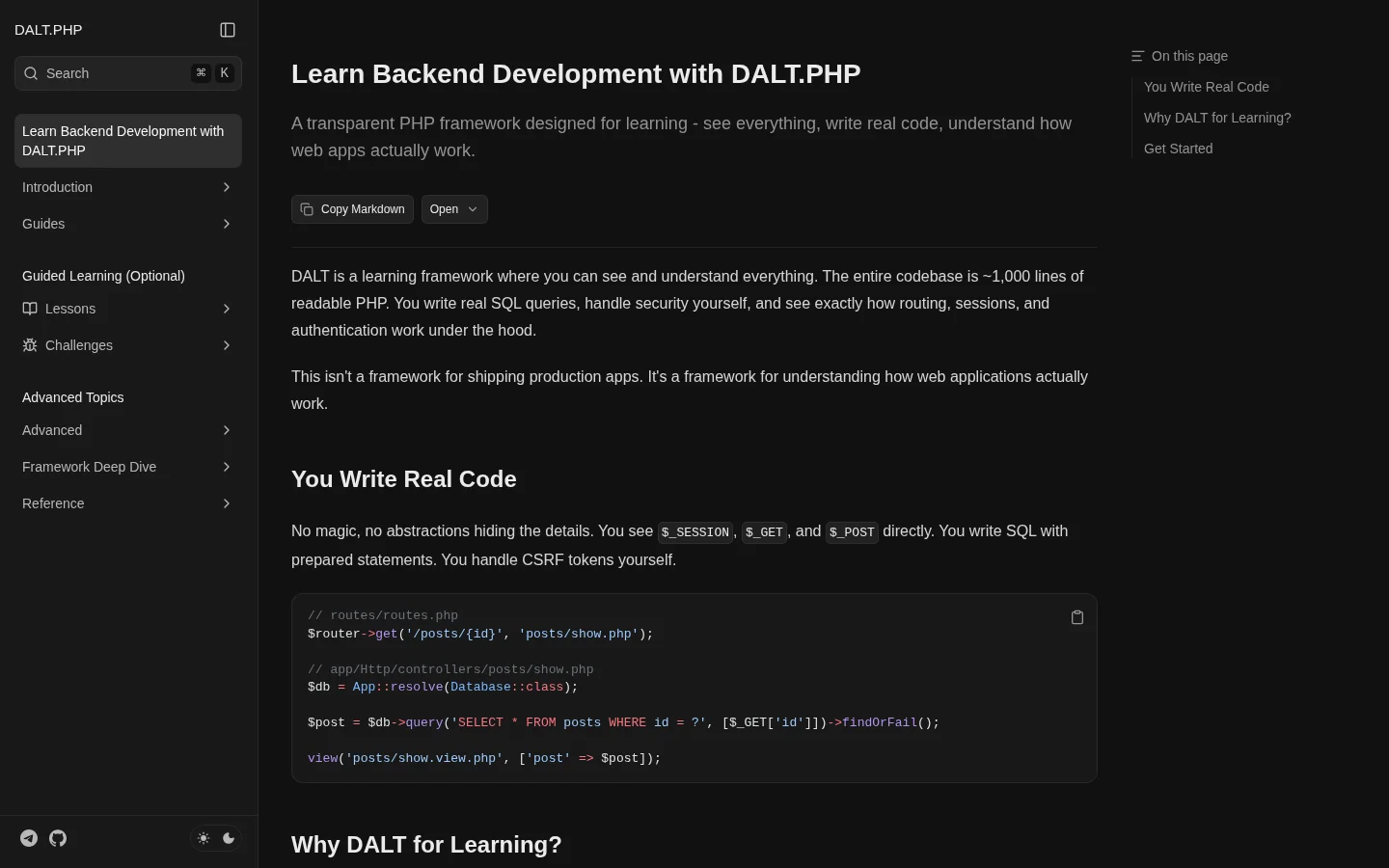
A small PHP framework that doubles as a place to learn backend systems by debugging them.
At a glance
The work before the feature list
- Problem
- Backend tutorials often explain the happy path without letting learners investigate the failures that reveal how a framework actually works.
- Role
- Creator & Developer
- Context
- Independent open-source project
- Period
- Jun 2024 - Present
Outcome
An actively maintained open-source framework, CLI, and guided learning system with public documentation and real debugging exercises.
The statement above describes verified shipped scope or current project status; it does not imply adoption or business metrics that are not available.
Decisions
What I chose and what it cost
Product decision
Keep the framework useful without the lessons
- Context
- A learning tool can become limiting when the educational layer is inseparable from the runtime.
- Choice
- Make guided learning optional and keep the framework capable of building ordinary applications.
- Tradeoff
- The framework and curriculum need separate, well-defined boundaries and documentation.
UX decision
Teach through deliberate failures
- Context
- Reading completed examples does not exercise the debugging process backend developers use in practice.
- Choice
- Give learners broken-code challenges that require finding, fixing, and explaining a failure.
- Tradeoff
- Challenges take more care to design and verify than a linear tutorial.
Backend decision
Expose the request lifecycle
- Context
- Heavy abstraction would hide the routing, request, and authentication concepts the project is meant to teach.
- Choice
- Use a lightweight architecture and document the path through the system.
- Tradeoff
- The framework provides fewer conveniences than a full production framework such as Laravel.
Context
DALT.PHP began as a way to make backend concepts inspectable. The framework is intentionally small enough for a learner to follow a request through routing, application code, and a response without treating the framework as a black box.
How it works
The framework can be used on its own, while the optional learning layer introduces deliberate failures around core backend concepts. Learners investigate the problem, make a fix, and use the surrounding explanation and tooling to understand why it works.
The CLI supports scaffolding and challenge verification so the learning loop stays close to a real development workflow.
What I am learning
The main product tension is keeping the framework small and understandable without turning it into a toy. That forces every abstraction to justify itself both as runtime code and as something a learner can reason about.
Ownership
What I was responsible for
- Product concept and learning model
- Framework architecture and implementation
- CLI tools, challenges, and documentation
Evidence
What can be inspected
- Public code
- Framework and learning system are available in the GitHub repository.
- Public documentation
- Architecture and usage guides are published with the project.
Contact